


Updated on 25 September 2026 with the product updates OpenAI announced to advertisers on 16 September.
Since 24 August 2026, ChatGPT has been showing ads across 31 European markets. Since 31 August, any company can buy that inventory on its own through the OpenAI Ads Manager. It is the first genuinely new auction since TikTok Ads, and for now a thinly populated one.
The market moved immediately. Performance agencies across Europe and Brazil announced ChatGPT Ads management services within the first week. The argument is always the same, and it is not wrong: new auction, few advertisers, click costs still low.
We tested the platform from a German account. Below is what the tool actually does, what it really costs, what changes compared with Google Ads and Meta Ads, what is new since September, and who should test it now.
What it is, in practice
The ad appears as a sponsored card directly beneath the answer from ChatGPT, clearly labelled as advertising. The documented format is the chat card: a title of 3 to 50 characters, a description of up to 100, an image, the favicon of the brand and a destination URL. For e-commerce, products from a feed can also surface as a carousel inside the conversation.
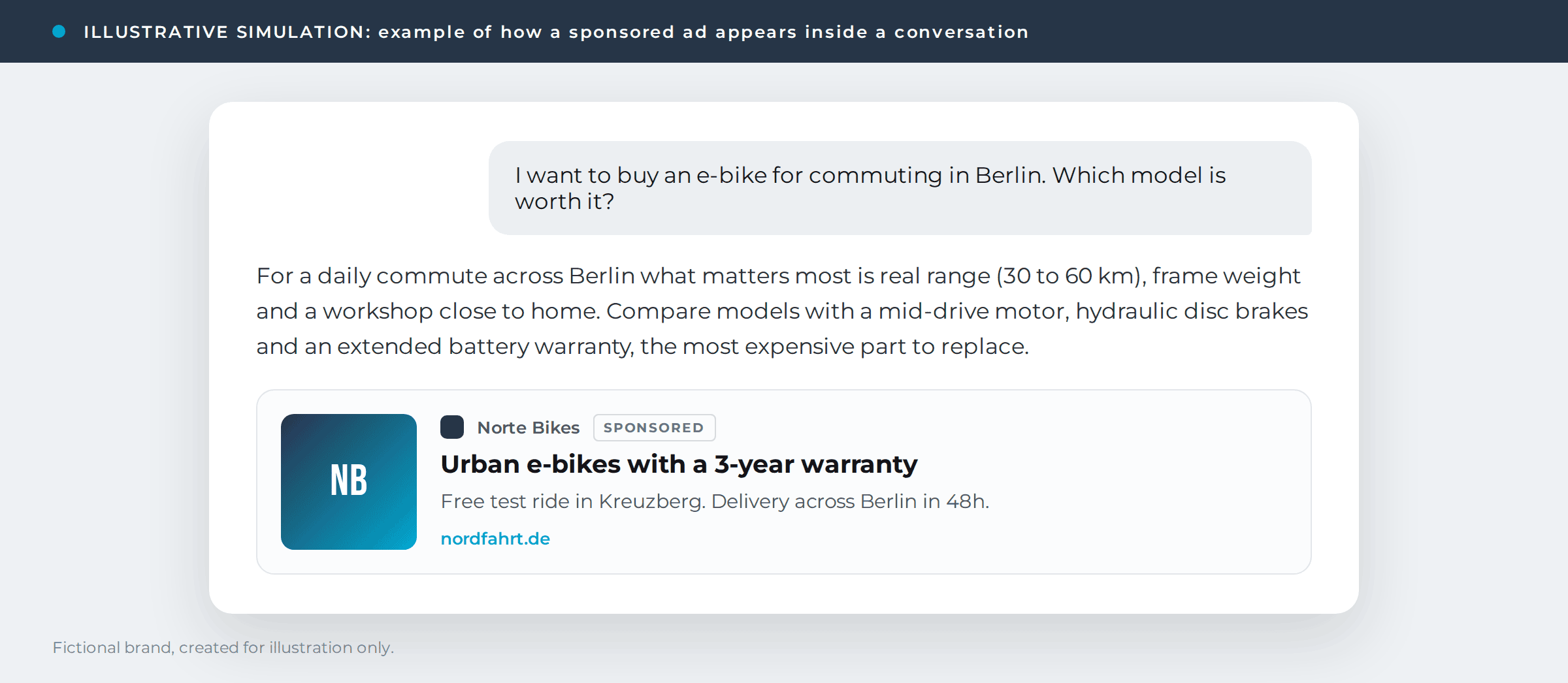
The audience is narrower than it first appears. Only signed-in users on the Free and Go plans, aged 18 or over, see ads. Plus, Pro, Business, Enterprise and Edu subscribers do not. Delivery is not constant either. Market estimates point to roughly one ad per four commercially oriented prompts, with fewer than 20 per cent of eligible users seeing any ad on a given day.
Targeting does not use keywords
This is the structural difference from Google Ads. Instead of buying search terms, advertisers describe contexts, the so-called context hints. They are situations and intentions: “comparing management software for small businesses”, “planning a move to Berlin”, “choosing a German course for work”. The ad is served when the conversation moves close to that context.
In the EU, at launch, ad selection relies only on the current conversation topic, approximate location, device type, language and time of day. Previous chats and memories are not used, and the stated legal basis is legitimate interest. Personalisation based on history is expected in a later phase, on an opt-in basis.
- Geographic: country level (state, DMA and postcode only in the US)
- Platform: Android app, Android web, desktop web, iOS app and iOS web, each targetable separately
- Custom audiences: a minimum of 25,000 matched users
- Demographic: not available
Setting up a campaign, step by step
- Account and verification. Signing up at ads.openai.com involves identity and business verification plus a valid payment card.
- Structure. Campaign, ad group and ads, following the same logic as Google and Meta.
- Objective and billing model. CPM (reach), CPC (clicks to site) or conversion optimisation. Since September, the option OpenAI recommends optimises for conversions from both ad clicks and ad views, billed per impression.
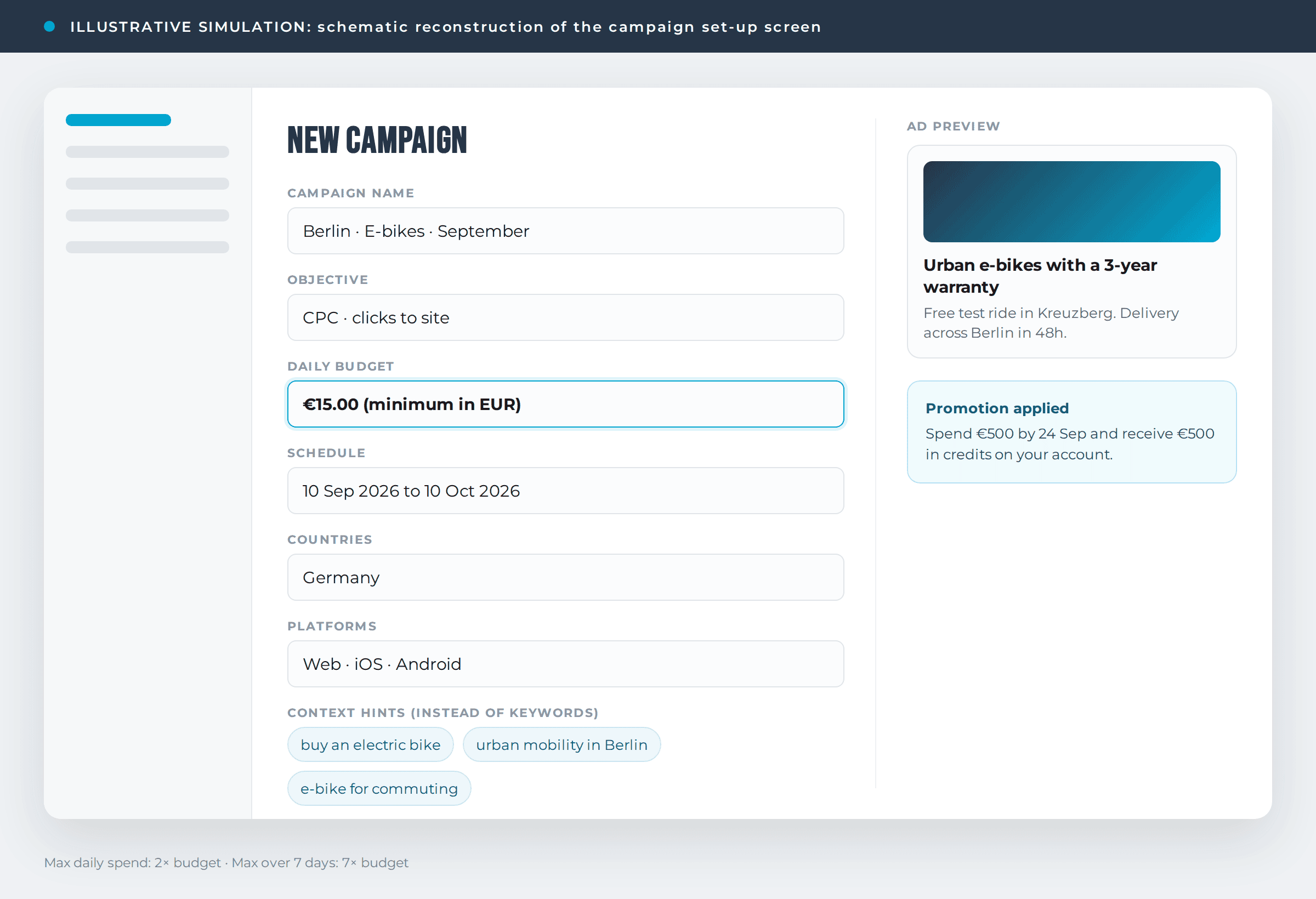
- Budget. Campaign total or daily. Delivery is flexible: the platform may spend up to twice the daily budget on a single day, within a ceiling of seven times the daily budget over seven days.
- Reach. Countries, platforms, flight dates and, where relevant, custom audiences.
- Creative and context hints. Title, description, image and URL, with three to five contexts per ad group. If you run campaigns in several European languages, consider text customisation, which adapts headlines and descriptions to the conversation and can translate them into the language of the user.
- Measurement. Install the pixel and/or the Conversions API. The landing page must be reachable by the OAI-AdsBot and OAI-SearchBot crawlers. If your site blocks those agents, the ad will not run. Once installed, check the Event Quality Score and set the attribution window you will report on.
- Review. Every campaign goes through human policy review before going live.
What it costs: 15 euros a day is the floor
Setting up a campaign for Germany, the minimum daily budget is 15 euros. The documentation from OpenAI confirms it with a table by account currency: 15 euros in the eurozone, 25 US dollars in the United States, 40 reais in Brazil.
There is no longer a minimum commitment. During the pilot, entry cost 200,000 US dollars, later reduced to 50,000. Today the channel is self-serve and the only floor is the daily budget.
On prices themselves there is still no official benchmark. The figures circulating come from the first months in the US market and are useful only as an order of magnitude:
- CPC: recommended opening bid of 3 to 5 US dollars, with values observed in live campaigns between 1.72 and 7.16
- CPM: maximum bid of 60 US dollars, with an average paid closer to 25
- CTR: between 0.65 and 1.57 per cent, well below Google Search at roughly 6.6 per cent, because users tend to carry on the conversation rather than click
A test that actually tells you something takes 15 to 30 euros a day over three to four weeks. Less than that produces data, but not a conclusion.
The 500 euro credit offer
OpenAI is repeating the classic Google Ads move to attract new advertisers: spend 500 euros, receive 500 euros in credits. On the account we tested, the offer carried a deadline of 24 September 2026, so that window has now closed.
The detail is worth reading. The credit is released only after the spend threshold is met, and the conditions covering deadline, eligibility and credit validity appear inside the account itself when billing is set up. For anyone who intended to test the channel anyway, it effectively doubles the budget of the experiment.
What changed in September: the latest OpenAI updates
On 16 September, OpenAI sent advertisers a roundup of new platform features. Some already apply to European accounts, others are still limited to the United States. Here is what each one means in practice for advertisers in Europe.
Available now for European advertisers
- Conversion optimisation with impression billing. Now generally available, this campaign type optimises for conversions from both ad clicks and ad views. Billing is per impression, while delivery works towards your conversion goal. OpenAI now recommends it as the default model for performance.
- Flexible attribution windows. When customising columns in Ads Manager, you can choose a 7, 14 or 30 day click window and a 0 or 1 day view window. The setting applies to every conversion column shown, which makes like-for-like comparison with Google and Meta much easier.
- Granular platform targeting. Android app, Android web, desktop web, iOS app and iOS web can now be targeted separately in Ads Manager and the Advertiser API, with performance insights split by platform. Useful in markets where the device mix differs a lot from country to country.
- HubSpot integration. Businesses on HubSpot can connect a ChatGPT Ads account, create ads, track performance and follow up on leads directly in the CRM. For B2B and service companies, that closes the loop between the click and the deal.
- Text customisation. An opt-in setting that adapts existing headlines and descriptions to the context of the conversation and can translate ad copy into the preferred language of the user. Across 31 markets and dozens of languages, this is potentially the most relevant update for Europe, but review how your brand voice and any regulated claims read after adaptation. You stay in control of whether it is switched on.
- Event Quality Score. Under Tools > Conversions, Ads Manager now gives eligible Pixel and Conversions API sources a setup score from 1 to 10, assesses user data coverage and suggests fixes. With consent rules limiting the data you can send in the EU, this is the first place to look before switching on conversion optimisation.
In testing or US only for now
- AI-assisted ad creation. The platform suggests copy and imagery based on your landing page and campaign objective, and you review and edit everything before it goes live. Currently in testing, with broader availability expected in the coming weeks.
- Shopify integration. For now, only US-based merchants can use the ChatGPT Ads app in the Shopify App Store to connect their catalogue and measurement, create campaigns and track results. OpenAI says international availability is planned for later in September, so European Shopify stores should keep an eye on it.
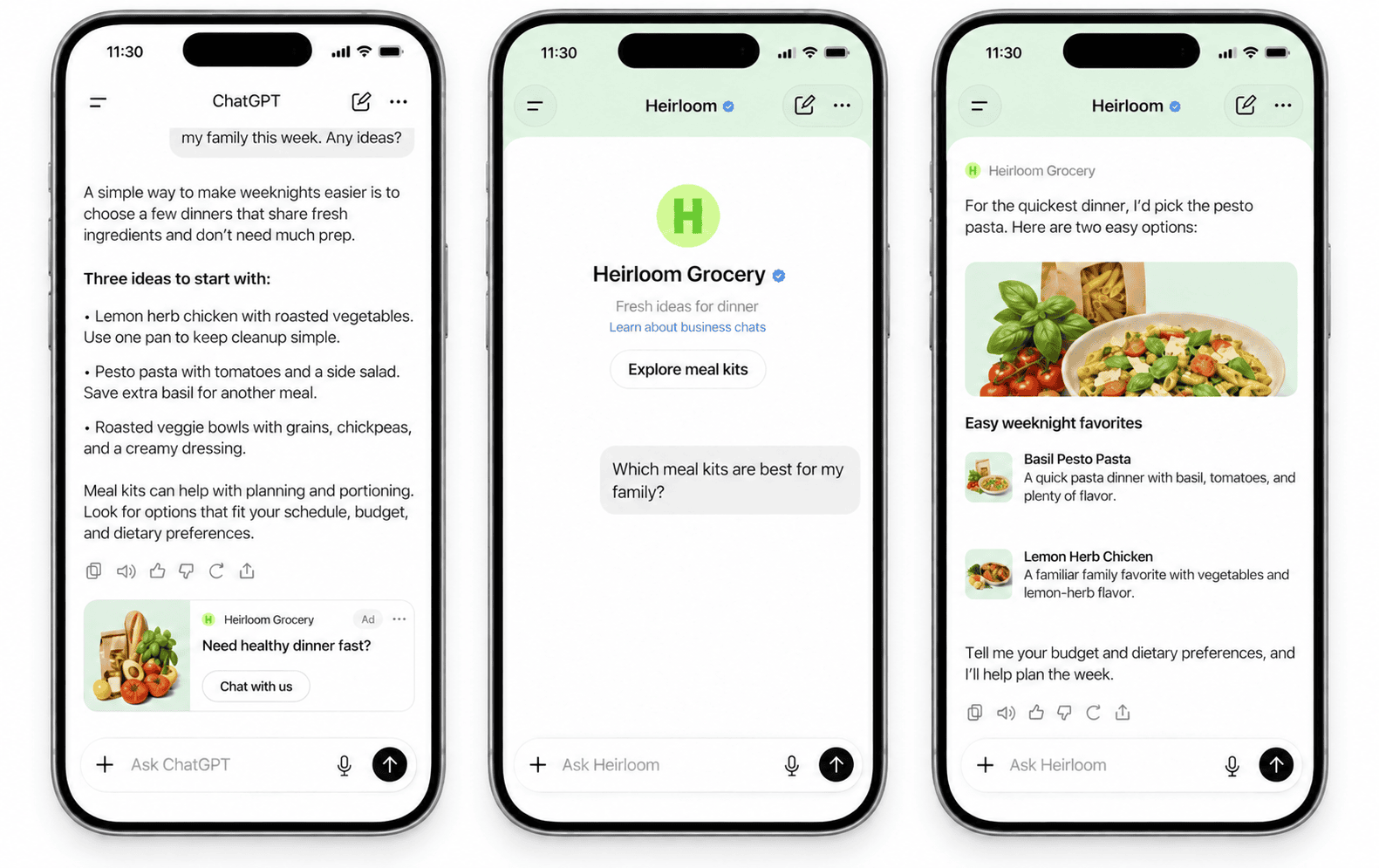
- Sponsored Agents. Being tested with selected advertisers in the United States. After clicking an ad, users may start a clearly labelled conversation with an agent sponsored by the business, to ask follow-up questions, compare options and learn about the offer. No date has been announced for Europe.
What this means for advertisers in Europe. The channel has matured on measurement. Conversion optimisation, configurable attribution windows and the Event Quality Score make it far easier to judge ChatGPT Ads by the same standard as Google and Meta. The precondition has not changed: without a well configured pixel and CAPI, set up in line with GDPR consent, the optimisation has nothing to work with.
Where the real opportunity sits
The “blue ocean” framing is true but incomplete. What genuinely changes against Google and Meta is the moment at which the brand appears. Not in a search for an isolated term, but in the middle of a conversation where someone is comparing options and forming criteria. That is a decision context, not a curiosity one.
It is worth testing now if:
- your average order value supports a CPC of 2 to 6 euros
- the purchase decision is researched and comparative, as in B2B, software, education, mobility, travel and specialist services
- you already have a pixel, CAPI and a landing page that converts
- you have incremental test budget, without cutting what already performs
It is not worth testing yet if:
- the business depends on high volume at low margin
- you operate in health or financial services, since those categories are not yet accepted outside the United States
- the expectation is to replace Google or Meta, because the reach of the channel is still a fraction of theirs
Checklist before the first campaign
- Business verification completed and billing configured
- Pixel and/or Conversions API installed and tested
- Event Quality Score checked under Tools > Conversions, with its recommendations applied
- Attribution window set in Ads Manager and aligned with the one used in Google Ads and Meta Ads
- Landing page reachable by OAI-AdsBot and OAI-SearchBot
- Three to five context hints per ad group, written as real customer situations
- Two or three creative variants with a short title, a concrete benefit and an image legible at small sizes
- Standardised UTMs so the channel can be compared with the others
- A fixed test window of three to four weeks, without touching the budget midway
- A decision metric agreed in advance, whether CPA or cost per qualified lead, measured against your Google Ads
Want to test ChatGPT Ads with a team already inside it?
Agência Lira plans and runs paid media for companies across Europe and Brazil, now including ChatGPT Ads, alongside Google Ads and Meta Ads. We assess which channel fits your business, build the campaign structure, write the creative and handle measurement end to end.
If you want to use the low-cost window of this channel, get in touch. We will look at your case and tell you plainly whether ChatGPT Ads makes sense for you now, or whether your money works harder elsewhere.
Sources
- OpenAI Ads, official platform page
- OpenAI Help Centre, campaign creation and minimum budgets by currency
- OpenAI Help Centre, how the daily budget works
- OpenAI Help Centre, conversion-optimised campaigns
- OpenAI Help Centre, Event Quality Score
- OpenAI Ads Platform, product update to advertisers, 16 September 2026
- Market data compiled from European trade publications, September 2026